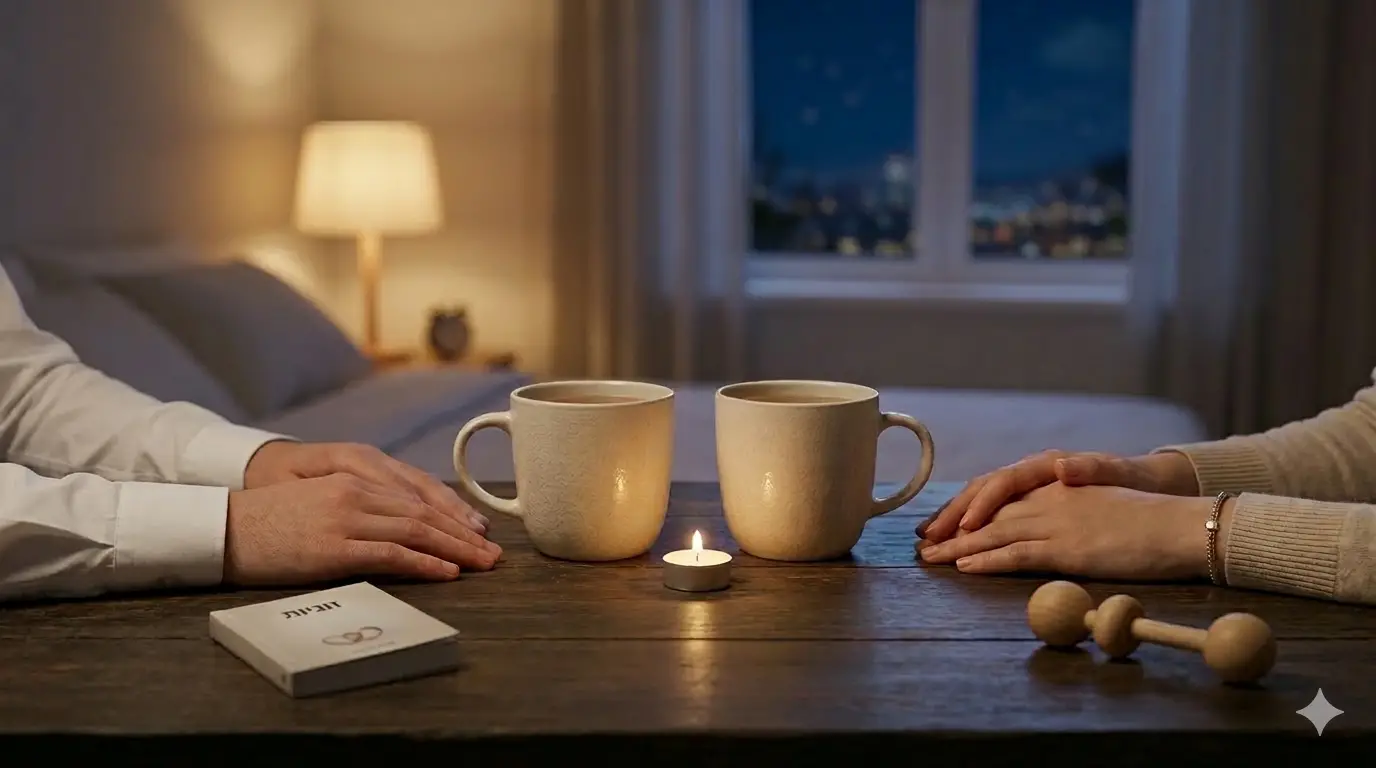


Relationship during war: a practical guide to maintaining the bond in times of emergency
One of the questions that keeps coming up among couples during this period is a question that almost feels uncomfortable to ask: how do you preserve your relationship when the war doesn’t end?
This question is not embarrassing at all. It is the question of mature people who understand that a home that breaks from within is no less vulnerable than a home damaged from the outside.
The reality for many families is complex: children at home, financial pressure, constant news updates, loved ones injured or lost, and a husband and wife trying to hold everything together. In all of this, the relationship is pushed aside—not out of neglect, but out of sheer inability.
This article offers practical tools to preserve the bond, even when it feels like there is no time, no energy, and no space.
What prolonged stress does to a couple
To use the tools correctly, it helps to first understand what is happening.
Research in crisis psychology shows that under prolonged stress, couples tend to go through three stages: in the first stage they mobilize together, in the second each partner turns inward and focuses on survival, and in the third, if not addressed, emotional distance becomes the new normal.
Most couples in wartime find themselves in the second stage. Each one functions, each one copes, but the connection between them is reduced to purely operational communication.
The good news: this stage is reversible. And the tools to change it do not require large amounts of free time—which most people do not have.
Tool A: A daily connection point
Gottman’s research found that the strongest predictor of relationship quality is not romantic dates, but the frequency of small “bids” for connection and responses to them.
In a household under pressure, these small moments disappear. Days pass without real emotional connection.
Practical implementation: agree on one short moment each day, five to ten minutes, where you ask each other a non-logistical question: “What was hardest today?” or “What do you need from me right now?” No fixing—just listening.
Even one simple touch per day has measurable effects on stress hormones and connection.
Tool B: Shared workload distribution
One of the most common sources of tension during crisis periods is the feeling that one partner carries more.
The solution is not to argue, but to coordinate.
Practical implementation: once a week, a 15-minute meeting: “What is hardest for me this week?” and “What do I need you to take from me?” This reduces resentment and increases teamwork.
Tool C: Protecting evening time
After the children go to sleep, many couples turn to phones. This is understandable—but it keeps the nervous system stimulated and reduces real connection.
Practical implementation: keep phones in another room for at least 20 minutes after the children are asleep. Use this time for quiet presence, conversation, or simply being together.
Tool D: Talk about fear, not only tasks
During wartime, most conversations become logistical. Real connection happens when emotions are shared and heard.
Practical implementation: every few days ask: “How are you really?” and allow space for an honest answer—without rushing to fix or calm. Sometimes the presence itself is enough.
About intimacy during stress
In prolonged stress, physical intimacy often decreases. This is a normal physiological response—when the nervous system is in survival mode, openness to closeness is reduced.
Halacha recognizes the importance of marital intimacy and the responsibility to nurture it. In difficult times, this means first recognizing where the other person truly is, rather than expecting them to be somewhere else.
Reducing pressure and increasing emotional presence often allows closeness to return gradually and naturally.
Additional tools that can help
Many couples find value in structured relationship tools during difficult times: guided books, couple games, or shared experiences that create small moments of connection.
These are not solutions to all problems, but they help keep the emotional “flame” alive during periods that tend to dim it.
In conclusion
“A helper corresponding to him” is not just assistance—it is partnership in facing reality together.
A relationship during war is not a luxury. It is the structure everything else rests on. Children who see parents holding each other through difficulty learn something no words can teach.
No perfection is required. Only intention: to notice, to ask, to touch, to remain present.
Couples who hold together through the storm carry a strength that cannot be replaced.
With prayers for peace, safety, and the return of all those serving—and for homes that remain warm even in the cold.